

Impact Of Rainwater Harvesting On Water Conservation And Communities
- September 30, 2024
ARCSA America Rainwater Catchment Systems Association 2024: The impact of large-scale rainwater harvesting as an integrated water management system on water conservation and communities with Jessica Johnson.
The American Rainwater Catchment Systems Association (ARCSA) was created to promote sustainable rainwater harvesting practices throughout the United States and the world. Learn more about ARCSA at https://arcsa.org/
Large-scale rainwater harvesting as an integrated water management system resolves water access issues while promoting sustainable stormwater management. The impact of rainwater harvesting on communities increases social welfare equitability by creating a renewable water source and decreasing flooding.
We’ll Examine:
a. The impact of commercial rainwater systems on communities
– Businesses
– Ranches, farms, agricultural
b. Land stewardship rainwater systems
c. Rainwater systems for fire protection
d. Residential rainwater programs impact on communities

Rainwater systems have an impact on the community around them based on:
1. The ability to produce water to replace, supplement, or provide a source of clean water that is accessible to its use
2. Rainwater is utilized primarily to increase crop/fodder/food/timber production or to provide domestic/public/commercial supplies of water
3. Stormwater is subverted and alternatively utilized in rainwater harvesting for flood control, reducing erosion
4. Rainwater systems are incentivized along with public education to encourage public participation
5. Water security improves sanitation, equalizes opportunities, and the well-being of the community

The impact of commercial rainwater systems on communities: Ranches, farms, agricultural
“Rainwater harvesting is a way of increasing the provisioning capacity at a specific location. Many rainwater harvesting interventions to date are primarily to increase crop/fodder/food/timber production, or to provide domestic/public/commercial supplies of water.” (“Rainwater Harvesting: A Lifeline for Human Well-Being.” 4)
Many studies prove that rainwater harvesting can increase crop and food production while building the watershed. Watershed Management Group in Arizona analyzed the effectiveness of rainwater systems, including for citrus production.
“A more realistic question isnot whether cisterns can provide adequate retention of stormwater, but whether water will be available when it is needed for landscape irrigation. For this exercise, the water harvested was compared with the plant water requirement for citrus trees… This analysis shows that cisterns can provide significant flood control and water supply benefits… Likewise, the simulation showed that harvested water could be used to grow citrus trees most of the year in most years… Cisterns can reduce runoff to predevelopment values for the 2 to 10 year events for soils with high runoff potential.”
(“A Prototype Analysis for Determining the Stormwater Retention and Water Supply Benefits of Cisterns.” 4) Watershed Management Group https://watershedmg.org/

Rainwater Harvesting Impact On Communities Increasing Social Welfare Equitability
The impact of rainwater harvesting on communities increases social welfare equitability by creating a renewable water source and decreasing flooding.
The Kerrville County Adult Detention Center utilizes a rainwater harvesting system for a garden that produces food for K-STAR, a local family shelter. The program focuses on teaching inmates proper farming skills and sustainable growing practices, as well as providing fresh food for the community. The garden would not have a water source otherwise in an area that typically relies on well water.
This rainwater system shows the importance of integrated rainwater management and its impact on water conservation and the communities that rely on it.

Rainwater Systems, Inc.
“In addition to residential and commercial water systems, we also offer designs and install remote rainwater systems to augment livestock and wildlife; as well as cabins with inaccessible surface water. Potable drinking water and remote watering systems save money while going green with a custom rainwater catchment system from Rainwater Systems, Inc. Backed by a lifetime of experience, we will design, build, and install complete rainwater collection systems for both potable and non-potable water.” Learn more about Rainwater Systems, Inc. at https://txrainwatersystems.com/
Decentralized Water Supplies And Local Food Security
“Rainwater harvesting can be instrumental to decentralized water supplies and local food security. Local food security is as important as national food security. It has been proven that the overall increase in crop output, mainly from the second crop, and from the establishment of homestead (kitchen) gardens, has had an impact upon the amount of food available for domestic consumption (Joshi et al., 2005). “ (“Rainwater Harvesting: A Lifeline for Human Well-Being.” 17)
One such example of rainwater harvesting increasing farm production is a system in Rowena, Texas. All-Tex Irrigation & Supply provided a rainwater harvesting system as the water supply for the High Cotton Farm. Rainwater is stored within an XLR 50/02 Pioneer Water Tank. Rainwater is naturally soft, and especially clean in the area of High Cottom Farm.
This enables High Cotton Farm to use rainwater for a more efficient crop spraying application since the chemicals perform better.
High Cotton Farm is seeing an increase in cotton production while using fewer chemicals in their crop spraying when they utilize rainwater as their water source.

All-Tex Irrigation & Supply
Established in 1987, we provide expertise in all your water needs. Serving San Angelo and the surrounding areas, we have solutions for irrigation systems, sprinkler systems, new wells, replacement wells, water pressure problems and booster pump systems, and more. Learn more about All-Tex Irrigation & Supply at https://www.alltexirrigation.com/
Rainwater Systems Providing a Water Supply for Livestock
Livestock producers require a consistent clean water supply that can be placed around a mile from each other for easy access. Rainwater systems are becoming a main source of water where the design focuses on the demand not exceeding the supply.
James Ranch in Wayne, Oklahoma utilizes a rainwater harvesting system designed and installed by Rain Ranchers.
The cattle ranch collects rainwater from their metal building rooftops and stores it within two XL 50/02 Pioneer Water Tanks.
The rainwater system produces a water supply for domestic, cattle watering, and ranch drinking water.
The amount of water available prohibits or promotes rangeland use by livestock.
When livestock producers utilize multiple rainwater systems across their rangeland, there is an increase in grazing and overall herd health.

Rain Ranchers
Rain Ranchers Helps North Texans Conserve, Appreciate, and Re-Use Rainwater. We Design and Install Rainwater Collection Systems That Reduce or Eliminate Your Dependability on Municipal Water While Lowering Your Monthly Water Bill. Learn more about Rain Ranchers at https://rainranchers.com/
Rainwater harvesting utilized for ranches, farms, and agricultural needs as compared to characteristics that increase their impact on community equality:
Rainwater systems are designed to meet the needs of the ranch or farm for which they supply water. Their efficiency in providing for that need determines the impact of replacing or supplementing the water supply.
Ranches and farms are focused on increasing production, and rainwater may be the best water source for this. Rainwater is soft water which can make crop spraying more efficient. Rainwater is proven to help plants grow when it naturally contains nitrates with a balanced pH.
Subverting stormwater as a water source increases flood control and reduces erosion around buildings at farms and ranches.
The level of education and involvement of the ranch or farm determines the rainwater system productivity and continuous maintenance.
Rainwater systems at ranches and farms can equalize opportunities for areas where a water source may be financially prohibitive or non-existent. Rainwater systems are a renewable alternative to paying for trucked-in water, water diversion, expensive desalination systems, or municipal water sources. This enables smaller ranches and farms to utilize a water source that otherwise would be prohibitively expensive.

Rain Ranchers
Rain Ranchers Helps North Texans Conserve, Appreciate, and Re-Use Rainwater. We Design and Install Rainwater Collection Systems That Reduce or Eliminate Your Dependability on Municipal Water While Lowering Your Monthly Water Bill. Learn more about Rain Ranchers at https://rainranchers.com/
The impact of commercial rainwater systems on communities: Businesses
One solution to the ongoing issue of clean water access is to incorporate rainwater harvesting into building and property development.
“In an effort to promote rainwater harvesting as a conservation tool, the Texas Legislature passed laws during the 2011 legislative session that impact the way that municipalities can regulate and provide incentives for rainwater harvesting.” ( “The New Landscape of Rainwater Harvesting and the Impact to Municipalities.” 1)
- The state of Texas is addressing this with one of the most comprehensive statutes on rainwater systems, Texas House Bill 3391.
- Texas HB 3391 promotes rainwater harvesting for potable and nonpotable uses. The bill incentivizes installing rainwater harvest systems in homes, businesses, schools, and government buildings. It also allowed for funding rainwater harvesting projects throughout the state.
- New government buildings that have a roof size of at least 50,000 square feet and are located in an area that receives at least 20 inches of average annual rainfall per year are required to incorporate rainwater harvesting systems for water supply for both indoor and outdoor use.
- House Bill 3391(2011) also requires the Texas Water Development Board to provide rainwater harvesting training to municipal permitting staff members.
Incentivizing Rainwater Harvesting for Water Conservation
The impact of Texas HB 3391 incentivizes building planners to focus on water conservation when designing new facilities. The Austin Central Library is one example of this with a rainwater harvesting system, condensate reuse, and reclaimed water strategy. The library collects rainwater and air conditioning condensation for use in water for flushing toilets and urinals inside.
“The rainwater/condensate collection and reuse provides an approximately 85 percent offset of potable water use,” said Lee Butler, the building services manager at the library. “So, 85 percent of the water we use is for flushing toilets and irrigation. We only use potable [water] for sinks, water fountains, ice machines, and the café.”
The One Water School in Wimberley uses 90% less water than a typical school of its size. The school utilizes rainwater harvesting, HVAC condensate collection, wastewater treatment, and reuse.
According to a Wimberley ISD press release, “the design for the school acknowledges the importance of protecting Jacob’s Well, Blue Hole, and the Trinity Aquifer by reducing groundwater consumption by 90 percent of what a traditional school this size would use.”

Demonstrating Rainwater Harvesting in Public Spaces
Watermark H2O supplied a rainwater harvesting system that acts as a demonstration for the community at the Central Home Supply store in Scotts Valley, California.
The system uses the metal building roof as the collection space with a gutter system that conveys the rainwater into the 3,000-gallon capacity Pioneer Water Tank.
The rainwater is used for irrigation for Central Home Supply and is a clean, renewable water source.
Santa Cruz County experiences clean water access issues and promotes rainwater as an alternative water source.
The demonstration rainwater system includes flyers with information and website links for residents to further learn about the alternative water source.

WaterMark H2O
We are committed to helping our customers Design, Build, and understand the benefits of water storage, Rainwater Harvesting, and Graywater systems while achieving independence. Learn more about WaterMark H2O at https://watermarkh2o.com/
Rainwater Harvesting for Stormwater Management
“According to a 2015 study conducted by Watershed Management Group, site-scale green infrastructure, when incorporated throughout a watershed, can make a significant difference in flood mitigation… WMG identified water-harvesting opportunities for streets, homes, businesses, schools, and churches within the Airport Wash area. Two scenarios were developed—one with 10% of private and public properties adopting green infrastructure features, and another with 25%—and both were evaluated for flood reduction and cost-benefit effectiveness. The results were impressive. (“Green Infrastructure For Desert Communities” 14)
In order to ensure the effectiveness of green infrastructure, Watershed Management Group identifies needs that can be replaced or supplemented with rainwater harvesting. Public education is given with each project which includes an ongoing commitment to the area and determining the effect of the green infrastructure.
The results are a reduction in stormwater flooding and an increase in resolving the issues that these project properties were facing.

“In this time of regional water shortages, many urban areas have the ironic problem of needing to manage “too much water” in the form of stormwater runoff… The LID/GI program simulates the pre-development hydrologic cycle – keeping water onsite, reducing off site runoff, filtering and biologically treating runoff, infiltrating water into the ground, and using it directly to replace potable water. This improves the quality of water infiltrating into aquifers, protecting and replenishing groundwater and drinking water supplies, and can stand alone or work in concert with traditional stormwater management.” (ARCSA Rainwater Harvesting Manual 18.3-4)

“Stormwater runoff is a leading cause of pollution of the nation’s waterways and a threat to public health that requires controls to prevent harmful pollutants from being washed by stormwater into local water bodies.” (ARCSA Rainwater Harvesting Manual 18.5)
Nationally recognized ARCSA recognizes that stormwater is a leading cause of pollution and that rainwater harvesting is an emerging solution. Keeping water onsite and reducing stormwater runoff through rainwater harvesting improves protecting and replenishing groundwater.
When businesses can utilize rainwater harvesting in their daily operations, they are actively improving the quality of water filtering into the ground while reducing dependence on public water systems.
Rainwater systems utilized by businesses have an impact on the community, increasing social welfare equitability based on:
Rainwater systems designed to meet the needs of the business can replace or supplement a water supply. Rainwater systems can completely provide a renewable source of water in areas where there isn’t another source.
A rainwater system that provides for a business that uses water reduces the use and reliance on municipal or groundwater sources.
Businesses can use rainwater systems for stormwater management. Businesses are required to alleviate flooding, and rainwater harvesting can reduce the impact of impervious surfaces.
Businesses that use rainwater systems act as a public education tool to showcase how they provide a water source and how they work. Businesses that people can visit daily can normalize rainwater harvesting by involving it in their property.
Businesses that use rainwater harvesting promote the alternative water source to customers and can open up the ability of businesses to run in areas where there isn’t a municipal water source which equalizes opportunities for companies.
The impact of rainwater systems on communities: Land Stewardship
“One underused method for attracting wildlife is the installation of watering devices to provide a supplemental source of water for animals. Land managers are also harvesting rainwater to distribute water on the landscape better, thus increasing the amount of usable space for wildlife… land managers should consider many factors, including the sources of water used by animals, the number and diversity of wildlife on the land, differences in mobility for various species, rainfall patterns in the area, and options available for harvesting, storing, and conveying rainwater.” (“Harvesting Rainwater for Wildlife AgriLife” 4)
Implementing rainwater systems as an integral part of land stewardship protects groundwater resources while providing a water source for supporting wildlife habitat.
Rainwater systems maintain ecological integrity while supporting the natural environment that in turn supports the community that relies on it.
Learn more about Wildlife Watering Systems, LLC at https://wildlifewateringsystems.com/

Rainwater Harvesting for Land Stewardship
Tanks Alot along with a local USDA office facilitated a rainwater harvesting system that utilizes Pioneer Water Tanks for storage. “The system installed by the Alabama Coushatta Tribe of Texas will allow them to harvest and store 65,000 gallons of rainwater which will be used for wildfire mitigation, irrigation of a community garden, and dust abatement in an arena adjacent to the Veteran’s Pavilion.” Read the full story with the U.S. Department of Agriculture:

The Alabama-Coushatta rainwater system will provide a new water source to encourage wildlife in the area. Stormwater is diverted into storage for later use, reducing flooding for the building. The community is heavily involved with the project, including the installation, and will continue to gather at the Veteran’s Pavilion to see the rainwater system working. The water source provides wildlife with water security, increasing land stewardship and restoration.
The Bureau of Indian Affairs Southern Plains Region (BIA) funded the cost of materials for the project and the Alabama-Coushatta Wildland Firefighting Crew Tribal members provided the labor.
At the time of the article’s publishing, around 32,500 gallons or about half of the Pioneer Water Tank had already been filled from rainfall.
Tanks Alot
Founded in 2012, Tanks Alot is a family-owned and operated business based in Boerne Texas, with a satellite location in Terlingua Texas. Owner Jesse Beavers is a US Army Veteran and an ARCSA Accredited Professional with design and construction knowledge of water storage systems. Jesse, along with dedicated employees and contractors form a team that can handle projects from small-scale rain harvesting to large-scale commercial projects. Learn more about Tanks Alot at https://tanksalottx.com/
“Using rainwater as an alternative supply for irrigation saves the cost of acquisition, treatment, and distribution of potable supplies.” (ARCSA Rainwater Harvesting Manual 15.3)
The future is bright for rainwater harvesting in land stewardship.
One example of this is “The NRCS Texas Urban and Rural Conservation Project will provide technical and financial assistance to entities to establish or improve gardens for food production, rainwater harvesting systems, gardens or habitats for attracting and maintaining pollinators like monarch butterflies, and the establishment of high tunnels to extend the growing season of fruits and vegetables.”
Learn more: https://www.nrcs.usda.gov/conservation-basics/conservation-by-state/texas/texas-partners-for-conservation
The NRCS Texas Urban and Rural Conservation Project has funded eight agreements through the USDA to utilize resources that address local issues.
One agreement is funding the Hill Country Alliance. The Alliance provides public education and events that focus on land stewardship and preserving the environment.
The Spring Water Revival, held in April, promoted rainwater harvesting for residents and businesses.
To increase the program’s impact we can use the grading structure to see if they could offer grants or rebates on rainwater systems in addition to providing public education. We will see how the Hill Country Alliance utilizes its new NRCS funding since it was allocated in 2023.

Rainwater systems through Land Stewardship have an impact on the community, increasing social welfare equitability and decreasing flooding based on:
Rainwater systems protect groundwater resources while providing a water source to support wildlife habitats. Supporting wildlife habitat maintains ecological integrity that in turn supports the community that relies on it.
Rainwater systems can increase watering sources for wildlife without affecting groundwater or reliance on municipal water sources.
Rainwater systems subvert stormwater for flood control and erosion reduction while building habitat
Rainwater systems for land stewardship encourage public participation and understanding of their natural environment.
Rainwater systems increase water security for wildlife. Implementing rainwater systems as a renewable water source equalizes community opportunities and increases public participation that relies on the natural environment.
The Impact Of Rainwater Harvesting for Fire Protection on Water Conservation And Communities
Properties that require a water source for fire protection are typically rural or large enough to require an additional supplemented supply. Fire protection may involve fire sprinkler systems, a water source for firefighters, firefighting pumps, etc.
While systems may be supplied by trucking in water or relying on an existing water main, rainwater harvesting is a sustainable water source. Rainwater harvesting can act as a backup or main water source that provides firefighters with additional water to suppress flames, protect property, and prevent the spread of the fire.
The National Fire Protection Association creates the Codes and Standards cited in Fire Codes for the Authority Having Jurisdiction. The NFPA includes rainwater harvesting as a source of water for fire protection:
“NFPA 23.2.1 Water supplies for sprinkler systems shall be one of the following or any combination… The capture of rainwater is generally not considered a problem since NFPA 13 has long allowed the use of open lakes, rivers, and ponds, which are nothing more than open collections of rainwater and melted snow.”

Rainwater Harvesting for Fire Protection
Utilizing rainwater harvesting in fire protection systems is cost-effective and sustainable. Adding a water storage tank approved for fire protection can save on insurance costs and help to decrease liabilities. Adding a water tank fire protection system supplied by rainwater instead of a hydrant system saves costs up front and over time.
Hydrant-based systems require extensive piping connections to a water main that a rainwater harvesting system may not need.
One example of a rainwater-based fire protection system that was utilized during an emergency is how the Nichelini Family Winery dealt with the Hennessey fire. The Nichelini Family Winery gave firefighters access to their XLE 50/03 Pioneer Water Tank during the Hennessey Fire which helped to bring an end to the fire.
“ We’ve prepared for fire every year,” he said. “The fire can be overwhelming. You just do the best you can.
Winery employees had cut firebreaks on the property and worked as guides for firefighters, showing them how to tap into the winery’s water system and the best places to battle the fire. Still, Sunseri was worried it may not be enough. ”
The rainwater system producing enough water to fill the Pioneer Water Tank enabled the firefighters to tap into 100,000 gallons worth of water. The news article about the system informs the public about this water access solution. The rainwater system provided water security for the fire emergency and acted as a water backup for the winery.

Rainwater Harvesting as a Water Source for Fire Protection
ARCSA recommends
“Above-ground concrete tanks or metal tanks can also be used effectively – unless the outsides of metal tanks get so hot that liners are impacted… A dual-use rainwater tank can reserve a portion of rainwater for fire fighting while allocating the other portion for ongoing site needs.”
(ARCSA Rainwater Harvesting Manual 16.3)

The Australian Bushfire CRC and CSIRO researched and analyzed Pioneer Water Tanks’ ability to withstand fire immersion in 2007.
The research project proved that Pioneer Water Tanks can withstand 30 minutes of full fire immersion without affecting the tank structure or liner.
The ability of Pioneer Water Tanks to withstand fire immersion means that they are capable of providing water storage during and after a fire emergency.
Rainwater Systems at Fire Departments Provide a Water Supply and Public Education
Rain Ranchers worked with the Upper Trinity Groundwater Conservation District to provide a rainwater harvesting system at the Central Community Volunteer Fire Department. The VFD is located in Weatherford, Texas. Rainwater is stored within a Pioneer Water Tank that includes fire fittings for easy access and to fill up the trucks.
The Central Community VFD rainwater system is an easily accessible water supply for filling up fire trucks. The rainwater system replaces the reliance on a water main. Stormwater is subverted around the VFD building. The VFD rainwater system showcases to the local community how water can be sourced alternatively. The VFD is a central part of the community and the addition of the rainwater harvesting system encourages sustainability.

Rainwater Systems Can Provide a Water Source for Dual Purposes Including Fire Protection
Cqure Water designed and installed a rainwater harvesting system for a central Texas home. The rainwater system provides a water supply for domestic irrigation use as well as serves as a backup water source for firefighting. The two Pioneer Water Tanks are approved by the North Hays County Fire Marshal’s office for a letter to the homeowner’s insurance company to assist with a discount for having water available to fight a fire.
The rainwater system for the central Texas residence produces enough water to use for irrigation and keep in store as a backup for firefighting. This rainwater system replaces the reliance on the public water main. Stormwater is subverted around the residence that is in an area that typically floods. The residence is private and doesn’t serve as a public educational tool but does encourage individual water security.

Cqure Water
Cqure Water began as Harvested Rain Solutions in 2013, when the founder, Ron Van Sickle, discovered the well at his Central Texas residence was running low. An engineer by trade, he applied his practice to design a cost-effective rainwater collection system for homes and ranches in Central Texas.
Ten years later, Cqure Water has installed hundreds of collection systems and storage tanks, providing a reliable and delicious water source.
Learn more at https://cqurewater.com/
The Impact Of Rainwater Harvesting for Fire Protection on Water Conservation And Communities based on:
Rainwater harvesting can replace, supplement, and provide a clean source of water for fire protection.
When rainwater harvesting is utilized for fire protection instead of another water source, it decreases the reliance on domestic/public/commercial supplies of water.
Stormwater is subverted with rainwater harvesting for fire protection.
Fire protection is integral to public safety and when infrastructure can be sustainable like with rainwater harvesting, it acts as an educational tool for the community that relies on it.
Rainwater harvesting can provide a water supply for fire protection in areas where a municipal water supply isn’t present and this increases community safety and opens opportunities for rural development.

The Impact Of Residential Rainwater Harvesting Programs on Water Conservation And Communities
“There is increasing evidence that watershed management with rain water harvesting has strengthened social capital which in turn can have a significant impact on the development of other ecosystem services for human well-being. (“Rainwater harvesting: a lifeline for human well-being” 9)
Clean water access is a worldwide issue that cannot be addressed with one solution. Rainwater harvesting produces water that can replace, supplement, or provide a source of clean water.
This source of water increases community production while managing stormwater. Rainwater harvesting on a residential level is water security that can improve sanitation and equability.
“About one-sixth of the world population – a total of 1.1 billion people – remains without access to improved drinking water, and 84% of these live in rural areas. In addition, 2 of the 2.6 billion people without access to basic sanitation live in rural areas (UNICEF& WHO, 2006).”

Ongoing Public Education Increases Success with Rainwater Programs
“Outreach was effective in changing perceptions on rainwater catchment as evidenced by individuals’ reported beliefs before and after engagement. The majority (N=75) of all survey respondents reported they will change how they maintain their catchment systems, and over 50% (N=61) reported they will change their catchment system elements, as a result of outreach. We conclude there is a demonstrated need for ongoing, professional, evidence-based outreach programs to serve rainwater catchment system users in Hawaii.” (“Survey of Rainwater Catchment Use and Practices on Hawaii Island” 33)
Go to resource: https://www.ctahr.hawaii.edu/hawaiirain/Library/papers/Non-conference%20papers/Rainwater_Harvesting_UNEP.pdf
The extensive outreach in the Hawaiian island communities demonstrates that rainwater systems vary in use and system adequacy. The increase in public education is effective in changing perceptions on rainwater harvesting, with 75% of respondents reporting that they will change how they maintain their systems, and another 50% of respondents reported that they will update their rainwater system.
Public outreach along with continuous public education increases the probability of rainwater harvesting producing water on the Hawaiian islands to replace or supplement residents’ clean water source. Rainwater systems differ on whether they supply domestic and or drinking water for residences. Stormwater on the islands is subverted along the flood-prone islands.
The University of Hawaiʻi, local organizations, along with the state and local governments provide continuous public education and water testing. The increase in rainwater harvesting on the Islands correlates with water security.
Making a Community-wide Impact with Rainwater Harvesting
The Watershed Management Group in Tucson, Arizona is an exemplary example of public education in action. The nonprofit organizes community-based solutions for a long-term impact on the environment.

One central focus of WMG is rainwater harvesting which includes public gardens that hold events, rainwater workshops, providing free resources, and implementation of rainwater systems on a commercial and residential level.
“According to a 2015 study conducted by Watershed Management Group, site-scale green infrastructure, when incorporated throughout a watershed, can make a significant difference in flood mitigation.” (“A Prototype Analysis for …Cisterns.” 14)

“One study showed that the amount of water delivered by Tucson Water in an average year is approximately equal to the average annual rainfall falling in Tucson (Yoklic, 2006). … Homeowners are motivated to install cisterns for the on-site benefits of water conservation and on-site drainage control. However, off-site benefits, such as reduced flooding, can be just as important.” (“A Prototype Analysis for Determining the Stormwater Retention and Water Supply Benefits of Cisterns.” 2)
ARCSA Provides Resources and Standards for Rainwater Programs
Setting standards for rainwater harvesting systems with nationally-recognized ARCSA helps to curb wide-scale mistakes like poor quality rain barrel distribution. ARCSA.org
Small-scale rainwater harvesting provides public education and can be utilized on a large scale in communities for water conservation and stormwater management.
There are many other benefits to a residential rainwater program, according to the ARCSA Rainwater Harvesting Manual. Rain barrels and small cisterns are great educational tools.
Small residential systems provide water for irrigation and other outdoor uses. Smaller systems show a trial of what rainwater harvesting can accomplish. Residential rainwater programs provide an inexpensive way to install, operate, and maintain a rainwater system. Small-scale rainwater systems are implemented on a large scale for water conservation, and stormwater management in municipalities. (Chapter 11 ARCSA manual)

The Impact Of Residential Rainwater Harvesting on Water Conservation And Communities based on:
Rainwater systems are designed and implemented on a residential level to produce water to replace, supplement, or provide a source of clean water that is accessible to its use.
Rainwater is utilized primarily to increase production or reduce municipal water reliance and use
Stormwater is subverted and alternatively utilized in rainwater harvesting for flood control, reducing erosion
Ongoing public education produces real results in residential rainwater systems. Rainwater programs require ongoing support to supplement or replace a municipal water supply and for stormwater mitigation.
Residential rainwater systems provide communities with water security that improves sanitation, equalizes opportunities, and the well-being of the community

Large-scale rainwater harvesting as an integrated water management system resolves water access issues while promoting sustainable stormwater management. The impact of rainwater harvesting on communities increases social welfare equitability by creating a renewable water source and decreasing flooding.
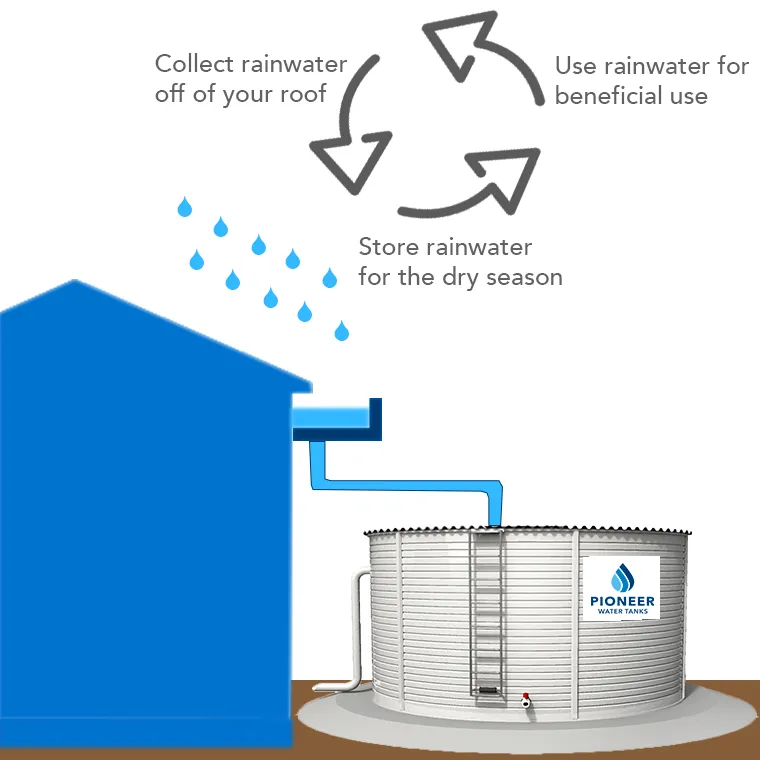
Rainwater systems have an impact on the community around them based on:
The ability to produce water to replace, supplement, or provide a source of clean water that is accessible to its use
Rainwater is utilized primarily to increase crop/fodder/food/timber production, or to provide domestic/public/commercial supplies of water
Stormwater is subverted and alternatively utilized in rainwater harvesting for flood control, reducing erosion
Rainwater systems are incentivized along with public education to encourage public participation
Water security improves sanitation, equalizes opportunities, and the well-being of the community
Contact your local Pioneer Water Tanks Dealer
Pioneer Water Tanks America operates with a network of accredited providers and installers for localized service.
Call or fill out the contact form to be connected with the closest provider today.

For advice on setting up a rainwater harvesting system, contact the team at Pioneer Water Tanks on (877) 223-7784 or fill in our form to enquire online.
Works Cited
Audry, A. (Ed.). (2015). The New ARCSA Rainwater Harvesting Manual. Tempe, Arizona; The New ARCSA Rainwater Harvesting Manual. https://arcsa.org/
Canfield, Evan, and Shipek, Lisa. “A Prototype Analysis for Determining the Stormwater Retention and Water Supply Benefits of Cisterns.” Pima County Regional Flood Control District, and Watershed Management Group, 2005.
https://watershedmg.org/sites/default/files/documents/a-prototype-analysis-for-determining-the-stormwater-retention-and-water-supply-benefits-of-cisterns_0.pdf
Cortesi, Luisa. “Rainwater Harvesting: A Lifeline for Human Well-Being.” University of Hawaiʻi, Stockholm Environment Institute, 2009, www.ctahr.hawaii.edu/hawaiirain/Library/papers/Non-conference%20papers/Rainwater_Harvesting_UNEP.pdf.
Donohue, Mary J. “Survey of Rainwater Catchment Use and Practices on Hawaii Island.” Wiley Online Library, University of Hawaii , 5 Sept. 2017, onlinelibrary.wiley.com/doi/10.1111/j.1936-704X.2017.3250.x.
Fancher, Kristen O. “The New Landscape of Rainwater Harvesting and the Impact to Municipalities.” Texas City Attorneys Association , Lloyd Gosselink Rochelle & Townsend, P.C. , texascityattorneys.org/wp-content/uploads/2013/06/RainwaterHarvestingandCities-Paper.pdf.
James C. Cathey, Russell A. Persyn, Dana O. Porter, Monty C. Dozier, Mike Mecke and Billy Kniffen. “Harvesting Rainwater for Wildlife.” Texas Natural Resources Server, Texas A&M AgriLife Extension Service, Feb. 2006, texnat.tamu.edu/files/2018/08/Water-rainwater-harvesting-for-wildlife-2006.pdf.
“Tanks on Trial: Performance of Rainwater Tanks in Bushfire Conditions.” Bushfire CRC, 2010,
https://www.bushfirecrc.com/sites/default/files/managed/resource/tanks_on_trial.pdf.


